Let's get the objection out of the way first: yes, you can tell when creative is lazy AI output. Plastic skin, cursed hands, that weirdly smooth "everything is an airbrushed render" look. When people say "AI ads don't work," that's what they're picturing.
But that's not an AI problem. That's a judgment problem. AI didn't make those ads bad. A human shipping the first draft did.
The short version
AI ads look like AI when someone ships the first draft. The fix is to let AI handle production and keep every decision human.
- Angles come from the account's data, not from the model.
- Every ad gets one job in the brief.
- Generate wide, then do a human pass: the real product, real claims, real typography.
- Winning concepts become cheap variations: new hooks, crops and headlines.
- The payoff is affordable testing, not better ads.
The principle: AI for speed, humans for judgment
My whole workflow is built on one split: machines do the production, humans do the decisions. AI never decides what to make, which angle matters, or whether an asset is good enough to carry a client's money. It just collapses the time between "brief" and "testable asset" from days to hours.
Pool rule 008AI for speed. Humans for judgment.
The pipeline, step by step
1. Angles from the data. Before anything gets generated, I read the account: which hooks are holding attention, which angles are fatiguing, what competitors are running repeatedly (if they keep paying for it, it's working). The output is an angle map: problem-aware vs product-aware, comparison, social proof, credibility, offer. This step is 100% human and it's where the ads are actually won.
2. Brief with one job per ad. Every creative gets a single job: stop the scroll with X, land claim Y, push offer Z. Briefs with three jobs produce ads that do zero jobs.
3. Generate in batches. This is where the tools earn their keep: Fal, Higgsfield, Nano Banana Pro, depending on the job. Product scenes, lifestyle contexts, background swaps, texture work. I generate wide: many options per brief, knowing most get binned.
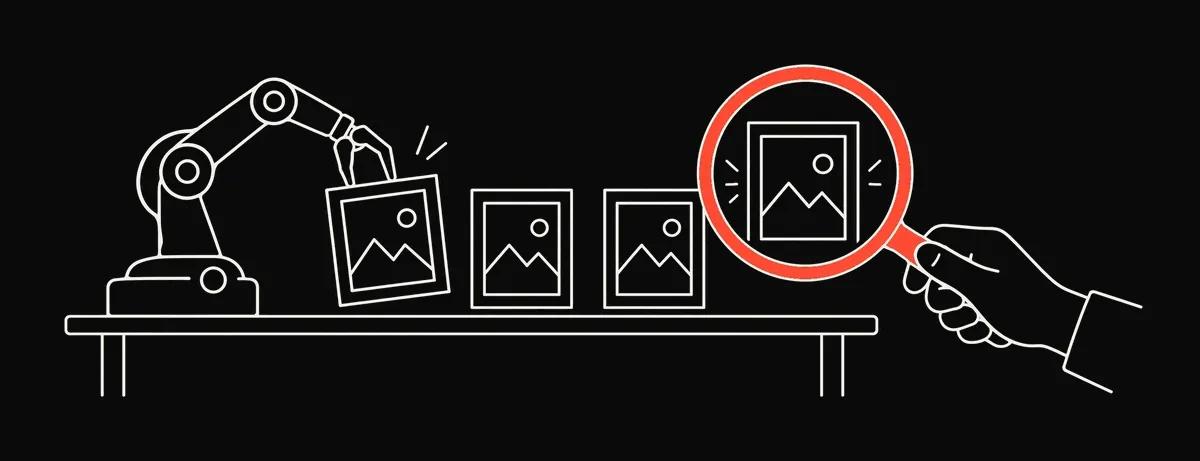
4. The human pass. Real product renders (never AI-invented products), real claims, real typography. Photoshop for compositing and cleanup, brand palette enforced, compliance checked. The AI look dies in this step. What survives reads like brand creative, because at the layers that matter, it is.
5. Modular variations. Winning concept → new hooks, new crops (1:1, 4:5, 9:16), new headline stacks. Variations are nearly free once the concept exists, and they're what keep an account fed between big swings.
What I refuse to let AI do
- Invent the product. The product in the ad is always the actual product. Non-negotiable.
- Write the claims. Claims come from the brand's reality and compliance, not a model's imagination.
- Approve itself. Nothing ships without a human deciding it would stop them mid-scroll.
Why bother? The economics.
Testing is a volume game: most ads lose, and the winners pay for everything. If producing one polished static takes your designer two days, you can't afford a real testing cadence; you'll protect every asset emotionally because it was expensive. When production is fast and cheap, you can let the data be brutal. That's the whole point: AI doesn't make better ads. It makes honest testing affordable.
Never run an ad you'd scroll past, no matter how fast you made it.
Quick answers
Do static ads still work? Yes. They are the fastest way to test new angles. More in static ads.
Do AI-generated ads work on Meta? They can, when AI handles production and a person picks the angle, checks the claims and approves every asset. Lazy first drafts are what fail.
Which AI tools do you use for ad creative? Fal, Higgsfield and Nano Banana Pro for generation, depending on the job, and Photoshop for the human pass.
Should AI generate the product in the ad? Never. The product in the ad is always the real product, and claims come from the brand, not the model.
How do you stop AI ads from looking like AI? A human pass on every asset: real product renders, real typography, the brand palette, compliance checks.